
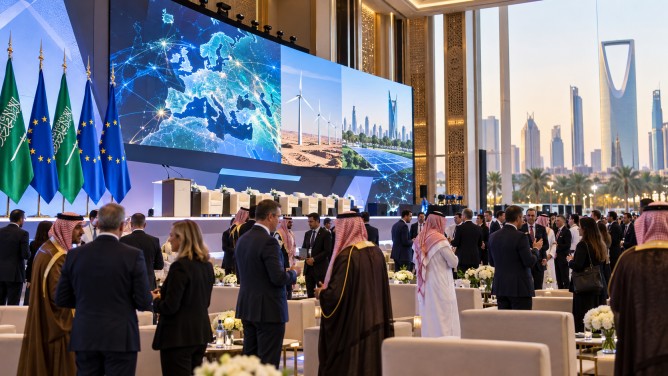
The upcoming EU-Gulf Cooperation Council (GCC) Summit in Riyadh on October 24 is set to emphasize expanding economic partnerships in artificial intelligence, digital infrastructure, clean energy, and advanced industries. This focus aims to deepen ties beyond traditional trade, as both regions seek to leverage each other’s strengths for mutual benefit.
Trade between the European Union and GCC nations reached €165.7 billion in 2025. However, both parties are now looking toward investment and long-term joint projects. Central to these discussions is the potential for collaboration in artificial intelligence, with investment opportunities spanning data centers, cloud computing, high-performance computing, AI applications, and cybersecurity. The Gulf’s investment capabilities, combined with Europe’s research and technological expertise, present promising prospects for partnerships in the burgeoning AI sector.
Digital connectivity is another key area of interest, extending beyond traditional transport and trade links to include telecommunications networks, data centers, cloud services, cybersecurity, and cross-border data infrastructure. This focus reflects a broader commitment to enhancing digital ties between the regions.
Clean energy is expected to remain a priority during the summit. Areas of potential cooperation include solar and wind power, green hydrogen, energy storage, smart grids, and emissions-reduction technologies. The demand for large-scale energy investment in Europe could align well with Gulf investors and European technology companies, fostering collaborations both within their markets and beyond.
The summit also provides a platform for discussions on advanced manufacturing, logistics, financial technology, healthcare technology, and industrial equipment. Such collaborations could gradually establish integrated value chains, enabling companies from both regions to engage in production, financing, development, and distribution.
While the EU-GCC free trade agreement remains a significant economic issue, with the EU seeking improved market access and clearer trade rules, no specific joint AI or technology investment projects have been announced yet. The discussions are expected to focus on transforming broader economic priorities into practical partnerships and investment opportunities.
For Saudi Arabia, this broader partnership aligns with the objectives of Vision 2030, especially in terms of economic diversification, attracting investment and technology, and developing non-oil industries. Additionally, the planned business forum alongside the summit will offer companies and investors a chance to explore potential projects in AI, data centers, clean energy, logistics, advanced industries, and financing.